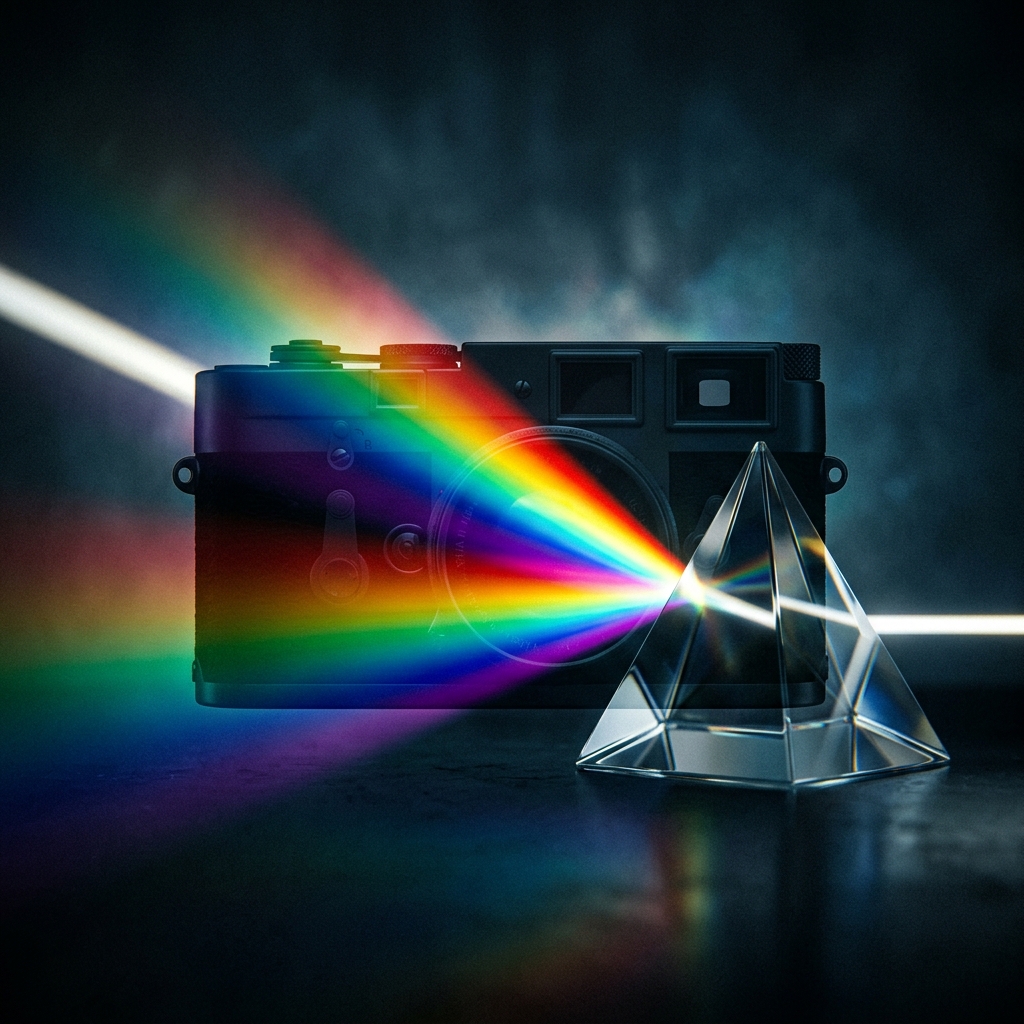
Have You Ever Actually Wondered How a Camera Works?
Most of us are so busy learning the "artistic" side of photography that we never stop to ask a pretty basic question: how does this black box actually turn light into a photograph?
I remember sitting in a lecture about camera sensors and thinking "this is literally physics class all over again." But once I understood what's happening inside my camera, I became a significantly better photographer. So stick with me here.
It All Starts with Light
Photography literally translates to "drawing with light." That's not a metaphor. That's exactly what happens. Light travels as electromagnetic waves, bounces off objects, enters your lens, and hits the sensor. At the sensor level, photons (tiny light particles) hit silicon cells and knock electrons loose. These electrons create an electrical charge. More light = more charge = brighter pixel.
That's it. That's the core concept. Everything else is just engineering to make this process better, faster, and more accurate.
Inside the Sensor
Your camera's sensor is basically a silicon chip covered with millions of tiny light-sensitive cells (photosites). When you press the shutter button, each photosite collects photons for a specific duration (your shutter speed), accumulates charge, and then the camera reads out all these charges simultaneously.
This analog signal gets converted to digital numbers by an ADC (Analog to Digital Converter). Those digital numbers become image data that the camera's processor turns into what you see on your LCD. Pretty insane when you think about it. All of that happens in milliseconds.
How We Get Color (It's a Bit of a Hack)
Here's the thing that blew my mind when I first learned it: your sensor is colorblind. Individual photosites can only detect how MUCH light they receive, not what COLOR it is.
So how do we get color? A Bayer filter. It's a mosaic of tiny Red, Green, and Blue filters placed over the sensor. Each photosite only sees one color. Green gets twice as many spots as Red or Blue because human eyes are most sensitive to green light (evolution doing its thing).
The camera then uses clever algorithms called "demosaicing" to interpolate the missing color information. Basically, if a pixel only captured Red data, the camera looks at the neighboring Green and Blue pixels and says "based on what's around me, I was probably this shade of full color." It's educated guessing. And it works remarkably well.
This is also why RAW files exist. They contain the actual, un-guessed data straight from the sensor. When you shoot RAW, you're telling the camera "don't guess for me, I'll do the processing myself in Lightroom."
The Lens: Bending Light on Purpose
Camera lenses are collections of precisely curved glass elements designed to bend (refract) light and focus it onto the sensor. Different elements correct for different problems like chromatic aberration (color fringing), distortion (straight lines bending), and vignetting (dark corners).
Modern lenses use aspherical elements, ED glass, nano coatings, and all sorts of exotic engineering to get light to behave. Next time you think a lens is "overpriced," remember there are literally 15+ glass elements inside, each ground to insane tolerances. Good glass is expensive because the engineering behind it is genuinely impressive.